Ask most marketing leaders how their teams are using AI right now and you will get one of two answers. Either a confident summary that does not quite hold up when the CFO asks what it is costing and what the business is getting back. Or an honest admission that nobody really knows.
Both answers point to the same reality. AI use inside most organisations right now is ungoverned, fragmented and largely invisible to the people who are accountable for commercial performance. Free accounts. Personal subscriptions. Shared logins. No standards, no visibility, no joined-up thinking about what is being used, by whom, for what, or at what cost. The tools arrived faster than the rules. That is not a criticism. It is simply what happens when technology accelerates beyond the pace at which organisations can respond to it.
But that window is closing. And the accountability question is already forming.
When Jensen Huang talks about tokens, marketing leaders should pay attention
In March 2026, Nvidia CEO Jensen Huang stood on stage at GTC (Nvidia’s annual technology conference) and proposed something that most people filed as a Silicon Valley curiosity. He suggested that engineers at Nvidia should receive a token budget worth roughly half their base salary, on top of their pay. His reasoning was direct. A $500,000 engineer who does not consume at least $250,000 worth of AI tokens in a year is, in his words, someone he would be “deeply alarmed” by.
Huang was not making a quirky tech compensation point. He was redefining what productive looks like.
Tokens, the units of data that AI language models process, are no longer a technical footnote. They are becoming a performance metric. The argument is simple. If you are not consuming AI tokens at scale, you are not using the tools that make you materially more capable. And if you are not more capable, the question of your value becomes uncomfortable.
That logic does not stay in engineering departments. It travels. And when it reaches the boardroom conversation about marketing investment, the question it generates is one most marketing leaders are not yet equipped to answer.
Token maxxing, burnt budgets and the limits of enthusiasm
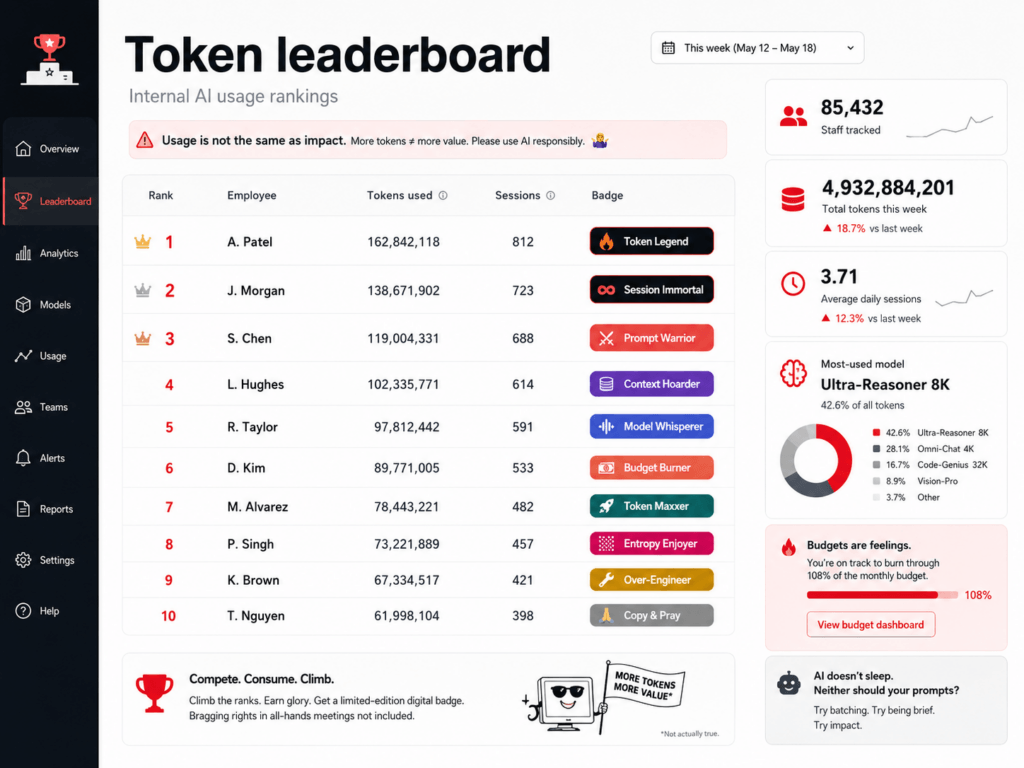
The first cautionary tales are already in. Meta employees built an internal leaderboard, nicknamed “Claudeonomics,” that ranked 85,000-plus staff by token consumption, awarding titles including Token Legend and Session Immortal. It was taken offline within 48 hours of becoming public. Amazon shut down its own token leaderboard after leadership concluded that employees should focus on solving business problems, not chasing usage figures.
Uber is the more instructive example for most organisations. It burned through its entire 2026 AI coding budget in four months. By May, its COO was saying publicly that it was becoming harder and harder to justify what the company was spending.
Around 70% of code committed at Uber now originates with AI. But drawing a straight line between that spend and commercial value remained, in the COO’s own framing, genuinely difficult.
That accountability gap is not unique to technology giants.
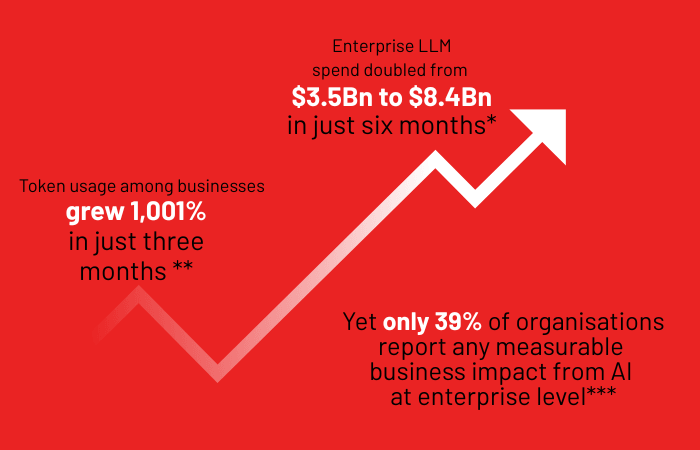
The tools are running. The returns are not yet visible. And somewhere in that gap sits a risk that goes beyond budget.
When every individual or team selects their own AI tool, the organisation never builds a shared picture of what is actually working. The paid media team learns one set of behaviours on one platform. The content team builds different habits on another. Three strategists are running their own free accounts. Nobody’s learning accumulates anywhere that benefits the business as a whole. Strategic thinking fragments. Institutional knowledge disperses. The organisation spends more, learns less and has no coherent view of the return.
There is also a structural risk hiding in plain sight. Many of the people using AI inside your organisation right now are doing so on free-tier or personally funded accounts. Free versions of most major LLMs train on the data fed into them. That means customer briefs, campaign strategies, competitive research and internal analysis may be leaving your organisation through a door nobody formally opened. Not because anyone behaved badly. Because the governance conversation has not happened yet.
Return on tokens (ROT) is not a metric yet and that is exactly the problem
ROI took decades to become the standard measure of marketing accountability. Then it arrived everywhere at once, and the organisations that had not built the frameworks to demonstrate it found themselves exposed.
Attribution followed. Then engagement. Then content performance. Each time, the pattern was the same. The tool scaled. The spend grew. The question came. And the organisations that had defined their own answer were in a fundamentally stronger position than those scrambling to construct one after the fact.
ROT is not yet an established metric. There is no industry standard, no benchmark report, no CFO asking for it by name. Not yet. But the conditions that create that question are fully in place. The spend is real and growing fast. The visibility is low. The outcomes are hard to demonstrate. And the most powerful technology company in the world has just told the market that token consumption is how it intends to measure the productivity of its highest-paid people.
The organisations that take that signal seriously now, the ones that start asking what they are spending on AI, who is spending it, through which tools and on which tier, and what the business is getting back for it, will not be scrambling when the CFO eventually asks. They will already have the answer.
The wild west does not stay wild indefinitely. Order arrives. The question is whether you are the one who brings it or the one who has to explain why you did not.
What does getting ahead of ROT actually look like in practice? That is the question this piece deliberately leaves open. Watch this space.
Frequently asked questions
What is return on tokens in marketing?
Return on tokens, or ROT, is an emerging accountability concept in marketing and business that asks what commercial value an organisation is generating from its AI token spend. Tokens are the units of data that AI language models process when generating content, completing tasks or running automated workflows. As organisations increase their use of AI tools, the cost of that usage, measured in tokens, is becoming a significant and often untracked line item. ROT asks the same fundamental question that ROI asks of any investment: what did we get back?
Why is AI token governance a marketing problem?
Marketing leaders are commercially accountable for the output, quality and risk profile of their team’s work. AI tools are now central to how much of that work is produced. If teams are using ungoverned AI tools, including free-tier accounts that may train on input data, the marketing leader carries both the financial and reputational exposure. Governance of AI use is not an IT problem or a legal problem. It is a leadership problem, and the marketing function sits squarely inside it.
Is tokenmaxxing a risk for marketing teams?
Tokenmaxxing, the practice of maximising AI token consumption as a proxy for productivity, carries a specific risk for marketing functions. Token volume does not measure output quality, strategic value or commercial impact. A team that optimises for AI usage rather than outcomes can generate significant cost and significant noise while producing very little of substance. The more immediate risk for marketing leaders is not that their teams are using too many tokens. It is that nobody currently knows how many tokens are being used, through which tools, at what cost, or to what end.

RELATED READING
B2B buyers are not as rational as you think. Here is what to do about it.