Listen to this article
11 min listen
AI doesn’t hold the budget or sign contracts. But it can influence which brands enter consideration, how your business is described and what evidence a buyer encounters first. If your brand is absent, mislabelled or thin on proof when a prospect asks an AI assistant to build a shortlist, you lose the race before you even know it has started.

Here is the argument in brief. Someone needs to choose a new CRM, compare private healthcare providers or find a specialist adviser they have never used before.
They could open a dozen tabs. Increasingly, they may ask an AI assistant to explain the category, compare the options or suggest a shortlist. The answer arrives in seconds. It may name a few brands, summarise their differences and point to evidence the person can check.
No purchase has happened. No one has been contacted. Yet the information frame around the decision is already taking shape.
Be honest. Aren’t you already doing this yourself?
The first conversation may happen without you
AI is not a customer. It has no budget, lived experience or personal stake in the outcome. It cannot feel reassured by your team or delighted by the result. A human still owns the judgement and other humans will often influence it.
But AI can act as an intermediary. It can gather information, compress it and present some options more prominently than others. That can influence whether a buyer finds you, understands you and decides you are worth investigating.
At Challenge, we define this role as an influential stakeholder. A system that must be understood and optimised for, just like a human buyer. The useful point is simple: AI will not buy from you (yet), but it can affect whether a human considers you. That does not mean adding Al-Go-Rithm to your customer personas just yet. It means understanding the part AI may play before your human buyer reaches you.
Lucy Allen, CEO, Challenge Marketing
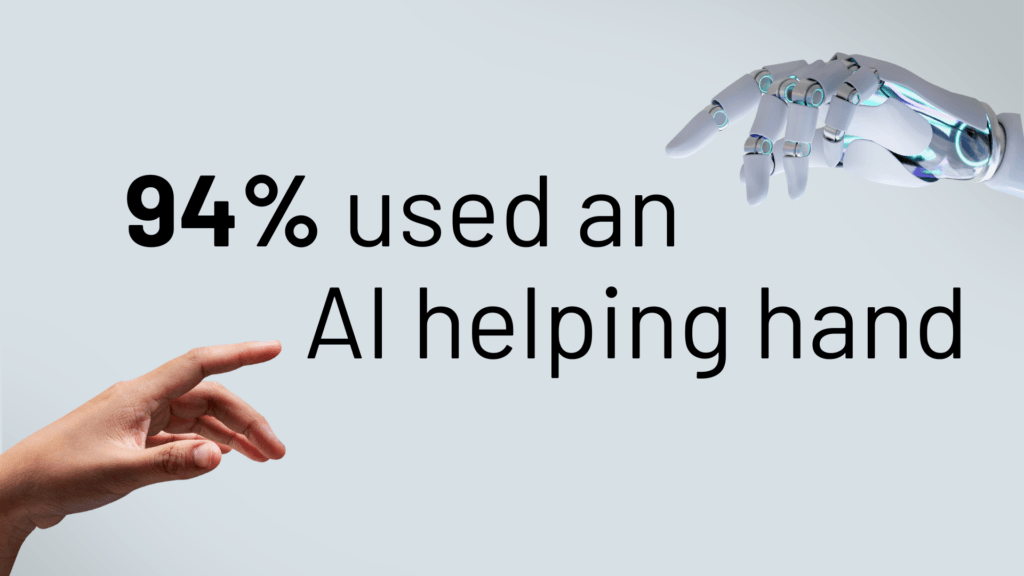
There is evidence that this is already becoming a normal part of business buying. Forrester reported in January 2026 that 94% of nearly 18,000 global business buyers used AI somewhere in the buying process. That does not mean 94% began with AI, trusted it most or let it make the decision. It means AI was present at some point in a very large share of the journeys studied.
This is not only a business-to-business pattern. Consumers are also using AI while researching more considered purchases.
Independent research did not start with AI
Buyers were researching suppliers before contacting them long before AI assistants arrived. They used search engines, review sites, analyst reports, colleagues and industry contacts. They narrowed the field because time and attention are limited. Behavioural scientists call this shortcut satisficing: stopping when an option feels credible and good enough, rather than proving it is the best one available.
AI may bring that stopping point forward. It can gather and compress information in one place, turning a crowded market into a handful of plausible options. If the answer feels sufficient, the search may pause there.
People rarely assess every possible option. We use shortcuts to make decisions manageable and often stop when something feels credible and good enough. AI may bring that stopping point forward, but the judgement, trust and consequences still belong to people.
Ginny Follen, Senior Behavioural Science and Marketing Strategist
This is where the idea of research shifting left is useful. More discovery, comparison and sense-making can happen earlier, before a supplier sees an enquiry or even knows research is under way. AI did not invent that behaviour. It can make it faster, more compressed and less visible. The answer is not final, but it is consequential.
This creates a dangerous blind spot for lean marketing teams. Your traditional dashboard shows zero traffic or intent from a target account. In reality, that account just used an AI assistant to filter down to a three-brand shortlist and your name was filtered out.
The same pattern shows up in consumer decisions, though at a more measured scale than much of the hype suggests. McKinsey’s June 2026 State of the Consumer survey of 4,863 consumers in Brazil, France, Germany, the UK and the US found that 28% of Gen Z respondents and 16% of baby boomers were using generative AI tools for shopping. It also found that consumers trusted generative AI less than most other sources used for product research.
So this is not a story about AI replacing every other source. It is a story about a new source of influence joining an already crowded research mix.
Technically present is not the same as clearly understood
A website can be live, indexed and full of content while the wider evidence about the organisation remains muddled.
Perhaps the company describes the same service in three different ways. Old positioning remains in directories or a rebrand has not reached biographies and profiles. The strongest proof is hard to find and important answers are buried in copy that assumes too much.
For a person, that creates friction. For a system trying to retrieve, reconcile and summarise information, it creates uncertainty. In both cases, uncertainty is not your friend.
Being mentioned is not the same as being understood. Being cited is not the same as being recommended. Being recommended is not the same as being chosen.
AI visibility cannot sensibly be reduced to a single ranking. What matters is whether the brand appears, whether its description is accurate, what supports it and what the buyer finds when they check.
What this can cost you
The first is absence. If your brand is not surfaced in a relevant AI-mediated interaction, it may not make that buyer’s shortlist. The opportunity is not certainly lost. They may search again, ask a colleague or already know you. But you have missed one chance to be considered. Visibility gets you into the conversation.
The second is misrepresentation. An old name, a vague category description or an incorrect claim can send the buyer down the wrong path. Sometimes the problem is not invisibility but visibility for the wrong thing. Clarity keeps you in the conversation.
The third is weak evidence. A brand may appear, yet the answer may have little credible material to support its expertise, difference or relevance. Visibility without proof creates awareness, not confidence. Credibility helps you win the conversation.
These are commercial problems because they affect attention before the organisation knows research is taking place. You cannot win a conversation you were never part of.
Visibility is an invitation to validation
Barbara Winters, VP and Principal Analyst at Forrester, puts the tension neatly: “Buyers lean on AI for speed and breadth of insight, yet they increasingly validate its output against trusted external sources.” That validation is not a failure of AI visibility. It is what useful visibility should lead to.
An answer can make a brand cognitively available. The website, evidence, reputation and human experience then have to justify the attention. Visibility creates an opportunity for consideration. Trust and judgement determine what happens next.
For brands, the opportunity is to make validation easier. Give buyers clear explanations, current facts, relevant proof and an experience that continues the journey they have already begun.
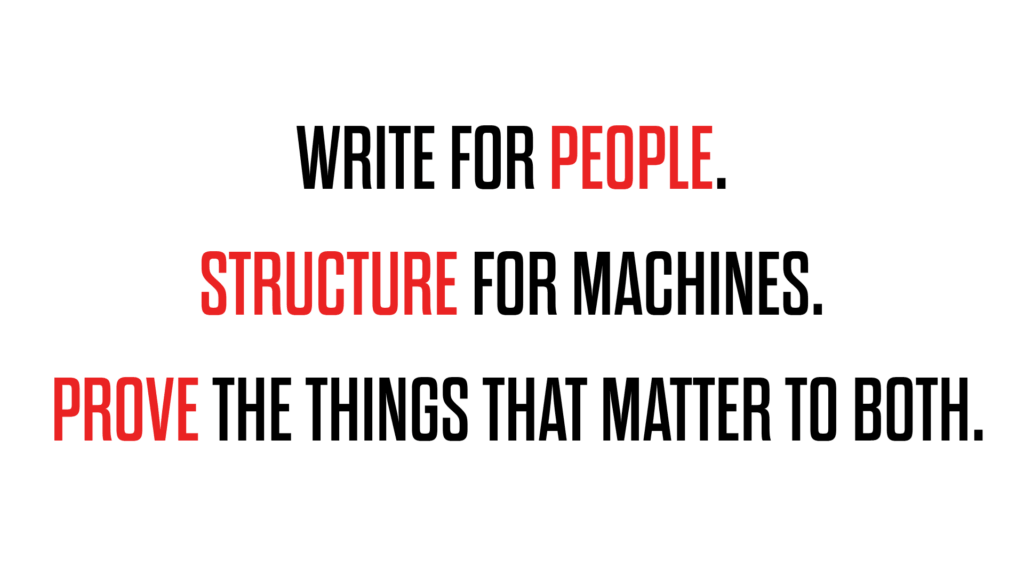
Write for people. Structure for machines. Prove the things that matter to both.
The temptation is to respond with a shopping list of technical fixes: add schema, publish dozens of FAQs, create an llms.txt file, then wait for the results.
There is no single switch. Google says plainly that its AI search features carry no special schema requirement and need no new AI text file. The familiar foundations still apply: content has to be crawlable, useful and available in clear text, with structured data that matches what a person can actually see on the page. That guidance describes Google’s own systems, not every AI assistant.
At Challenge, we look at this challenge through three operational pillars: Seen, Readable and Believed.
Each pillar begins with a human need and has a machine consequence.
1. Seen: Are you actually in the room?
Are you present in the sources and signals shaping AI answers, the places humans are looking?
2. Readable: Can you be understood?
Can humans and AI systems clearly work out who you are and what you do?
3. Believed: Do you have the proof to back it up?
Is the picture they form accurate, complete and supported by credible signals?
A manageable response, not another platform
For a lean marketing team, the challenge is rarely a lack of dashboards. It is deciding what matters, why the problem exists and how to coordinate the response.
Our founding cohort confirmed something important. Marketing leaders did not need another dashboard or isolated score. They needed a defensible interpretation, a manageable next move and a clear roadmap for acting on the evidence.
The practical sequence is straightforward.
- Measure honestly. Be clear about what has and has not been tested.
- Understand the cause. Different problems need different fixes.
- Prioritise action. Focus on the changes most likely to help buyers and machines.
- Test where needed. Use live-engine and technical checks to answer specific questions.
- Improve and remeasure. Connect movement to a commercial outcome, not just a score.
There is no new platform to learn or force through procurement. The work can sit across marketing already under way. One organisation may need a clearer service page. Another may need to resolve a fragmented identity, strengthen independent evidence or test priority buyer questions in live engines.
AI does not become the customer. It remains one influence among several. The buyer brings the need. Colleagues, family or friends may shape the decision. Budget and practicality ask hard questions. People experience the service and decide whether the promise was true.
But before any of that happens, AI may help decide which names are in the room.
That is why visibility matters. Not because machines have taken over the buying journey, but because engagement cannot begin with a brand that never enters consideration.
See how AI assistants describe your brand
Our free AI Visibility Snapshot shows how two leading AI assistants describe your brand today, in our test, and the quick wins to fix first.
We use your details only to prepare and send your Snapshot. Privacy policy
Suggested reading

B2B buyers are not as rational as you think. Here is what to do about it.
How bias, emotion and context shape B2B buying decisions, and what marketers can do about it.
The 30/60/90-day plan
What to understand first, what to act on and how to present a plan in a new marketing role. Free planner included.

The AI wild west has a new metric and it’s called R.O.T.
Return on tokens, the accountability question forming around AI spend right now.